SaaS AI Displacement Framework: A 2x2 to Know Your Risk and Build Your Defense – PART 1


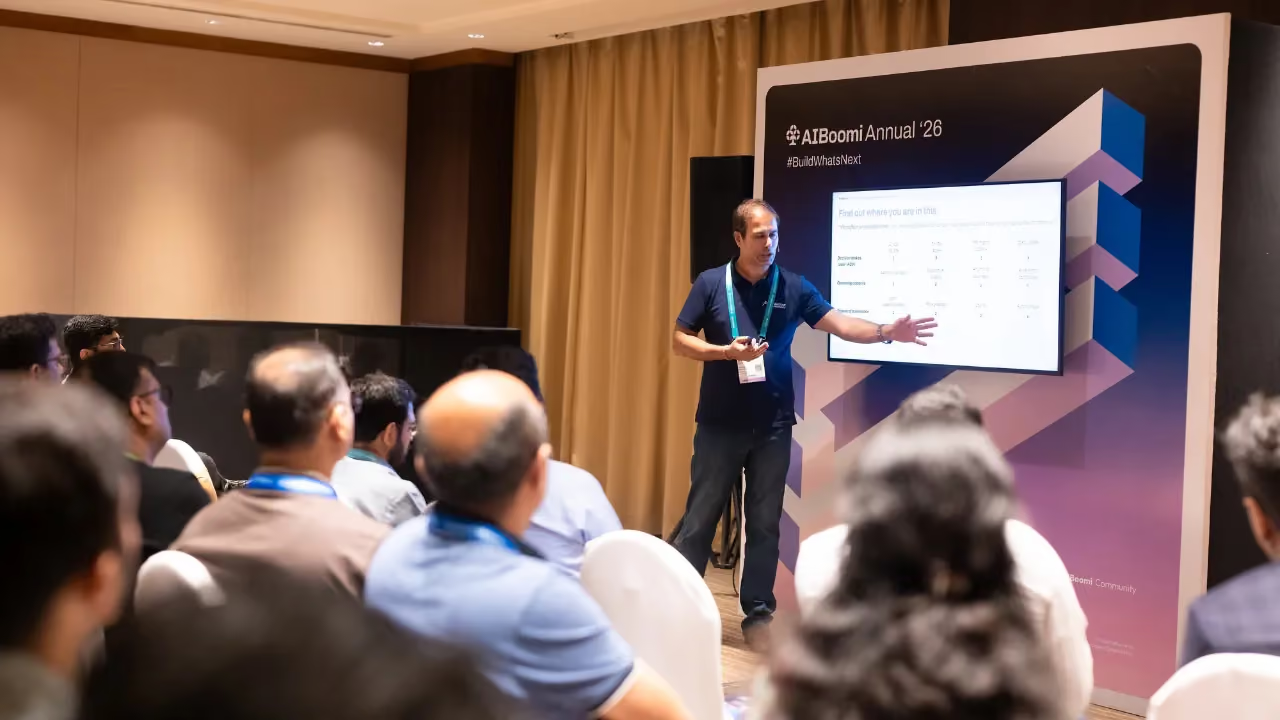
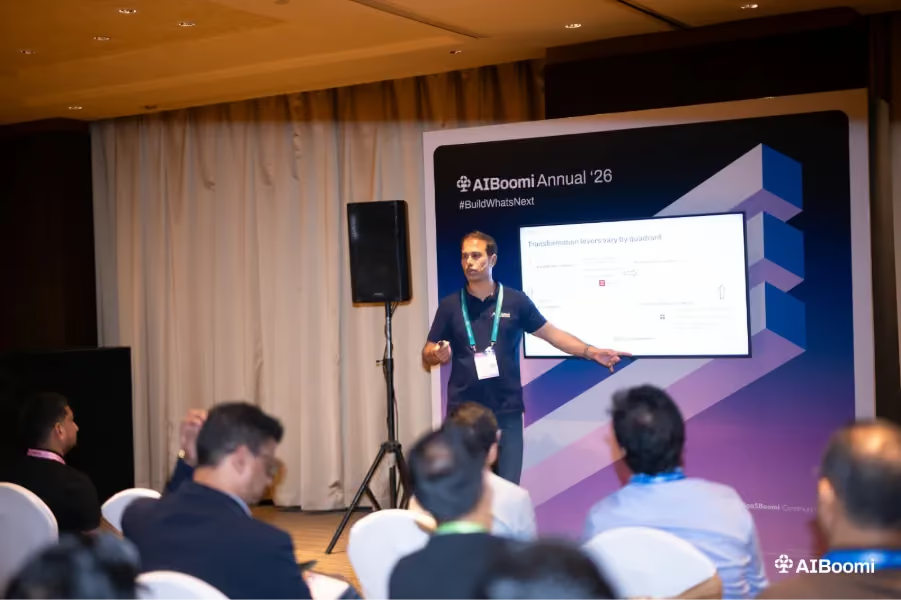
In March, I presented a framework at AI Boomi Annual '26 in Chennai to a room full of scaled SaaS founders. The session was meant to be a safe space — Chatham House rules, no judgments, no final verdicts. Just an honest conversation about a question most founders are thinking about, but few are discussing openly: how exposed is my software business to AI displacement?
The strong response & swarm of requests for follow-up conversations helped us realise this thinking exercise is relevant more widely as well.
We will cover this in two posts:
- The first part introduces the framework and builds shared understanding and alignment (the WHY).
- The second part focuses on the WHAT and HOW to leverage your current strengths, while also plugging some important gap areas to achieve long term success. So, here is our 2x2. Use it to self-diagnose. Be honest with yourself — that is the only way it works!
My Starting POV
The SaaSpocalypse happened in February. $285 billion wiped out in 48 hours. New VC funding is now flowing almost exclusively to AI-native companies. AI hiring has jumped 4x while we see meaningful layoffs and hiring freezes everywhere else.
My read: investors are over-reacting. But in most cases, founders are under-reacting.
The panic in public markets is indiscriminate — it hit every software company the same way. That is wrong.
Some SaaS companies are genuinely at high risk. Others are about to become more valuable than ever. The difference comes down to two dimensions.
The 2x2 Framework You Can Self Diagnose With
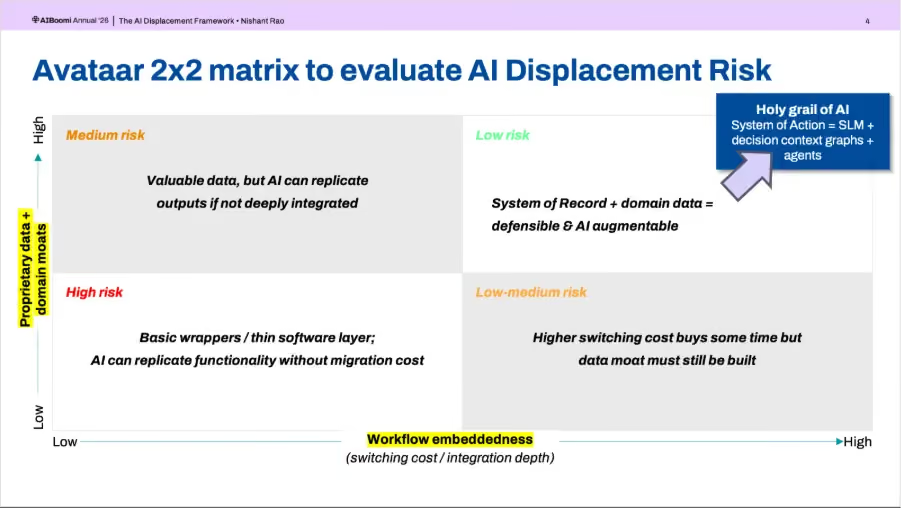
Using Avataar’s domain expertise in Enterprise tech & our privileged position to be able to look across many different companies and domains, we built this simple matrix (for internal use) to evaluate AI displacement risk. We continue to refine this over time.
The framework has two axes:
The Y-axis is Proprietary Data and Domain Moats.
The gut-check question: if OpenAI had access to all public data, could it replicate more than 70% of your value? If yes, you have a data problem.
The X-axis is Workflow Embeddedness.
The gut-check question: if your company disappeared tomorrow, how long would it take for your customer to recover? If the answer is "a week, a month or even a quarter," you have a switching cost problem.
Plot yourself on these two axes and you land in one of four quadrants. You can use the key below to interpret your risk of displacement.
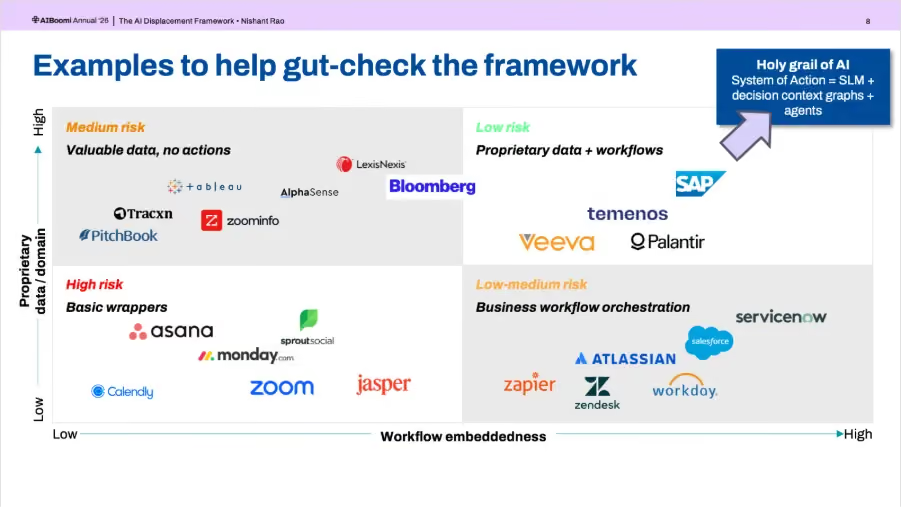
Bottom-left: Basic Wrappers (High risk).
Low proprietary data, low workflow embeddedness. Think productivity and collaboration tools, iPaaS and task automation, GenAI content wrappers. AI can replicate this functionality without any meaningful migration cost for the customer. The market is already pricing this in — these companies trade at less than 1-2x EV/NTM revenue today.
Top-left: Valuable Data, No Actions (Medium risk).
High proprietary data, but low workflow embeddedness. Think data aggregators, cybersecurity visibility tools, BI and analytics platforms. You have valuable data, but if you are not deeply integrated into the customer's workflow, AI can replicate the outputs. But with unique data being valued differentially in the AI-first word, these companies still trade higher at 3-4x EV/NTM revenue despite missing a workflow lock.
Bottom-right: Business Workflow Orchestration (Low-medium risk).
Low proprietary data, but high workflow embeddedness. Think Systems of Record — CRM, ITSM, HCM — and sales, CX, and marketing automation. High switching cost buys you time. But the data moat must still be built, or you are living on borrowed time. Trading at 2-3x EV/NTM revenue today.
Top-right: Proprietary Data + Workflows (Low risk).
High proprietary data, high workflow embeddedness. Think ERP/MES systems, core BFSI and healthcare platforms, vertical SaaS with deep domain context. System of Record combined with domain data makes you defensible and AI-augmentable. Trading at 6-8x EV/NTM revenue. The holy grail from here is becoming a System of Action — combining SLMs, decision context graphs, and agents (which trade even in a bear market at meaty EV/NTM Revenue multiples).
For example: Palantir exemplifies the holy grail of transitioning from a System of Record to a System of Action, leveraging its Ontology for high proprietary data integration (e.g., defense, BFSI workflows) and AIP agents with decision logic/actions for real-time operations. This deep embeddness in vertical domains like ERP analogs and healthcare enables AI augmentation while trading at premium 40-50x EV/NTM revenue multiples—even in the bear market post-SaaSpocalypse — far above the 6-8x.
The market is already differentiating. The valuation multiples across these quadrants are not just theoretical. They reflect how investors are pricing displacement risk today.
How to score yourself:
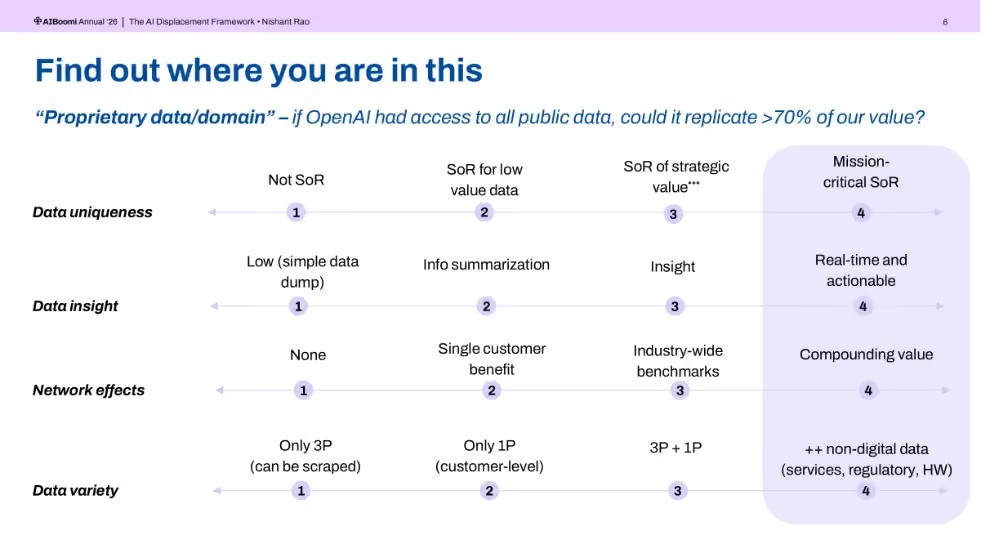
On Data uniqueness:
If you are not a System of Record, score yourself - 1
If you are a SoR for low-value data, score yourself - 2
If you are a SoR of strategic value, score yourself - 3
If you are a mission-critical SoR, score yourself – 4
IMPORTANT NOTE: It’s natural for each of us to assess ourselves as bringing “strategic value” to our clients. But if the data schema is universal and operational context (process logic, configurations etc) are generic / standardized, they become easily replaceable. That’s why we believe most SoRs should self-assess as a 2.
However, if there are additional unique angles relevant for your startup (deep compliance moats, custom & complex client business logic embedded into SoR, audit trail depth etc) then a score of 3 may be warranted.
Applying this caveat, it may be surprising that most SoRs, even though in seemingly valuable categories, should cap out around a 2 or 2.5 (eg. CRMs, HRMS, Ticketing, Marketing Automation etc). Compare these to ERP or Trading Systems and you should be able to understand why they are deemed more valuable.
On Data insight:
Do you provide a simple data dump, score yourself - 1
Are you providing information summarization, score yourself - 2
Are you giving genuine insight, score yourself - 3,
or real-time actionable intelligence, score yourself - 4
Network effects:
If you have None - 1
If you provide single customer benefit - 2
If you offer industry-wide benchmarks - 3
If your offer compounding value where the product gets better with every customer – 4
IMPORTANT NOTE: Our base definition of being able to create cross-customer benchmarks was leading to grade inflation. Hence, we refined our thinking further to assess this Network Effects dimension along three sub-dimensions – data flywheel (F), regulatory lock-in (R) & real-time / refresh cycle (RT). If you have neither F nor R, score is 1. If you have F or R then 2, to get a three you need F and R simultaneously and if you can also claim a real-time refresh cycle (making the data even more valuable) then 4 is warranted.
Best example to help bring this to life is Veeva (vertical CRM for Pharma). It can warrant a 4 because not only do they have multi-tenant data but it is industry specific (so clinical trial data from each client makes their dataset even more valuable) + embeds all mandated regulatory logic + scans & accumulates adverse events & related monitoring updates in real-time.
Data variety:
Only third-party (3P) data that can be scraped through your tool – 1
You only offer first-party (1P) customer-level data – 2
You offer first party & third party data combined - 3
3P + 1P plus non-digital data from services, regulatory, or hardware sources - 4
For Workflow Embeddedness, score yourself 1 to 4 on each sub-dimension:
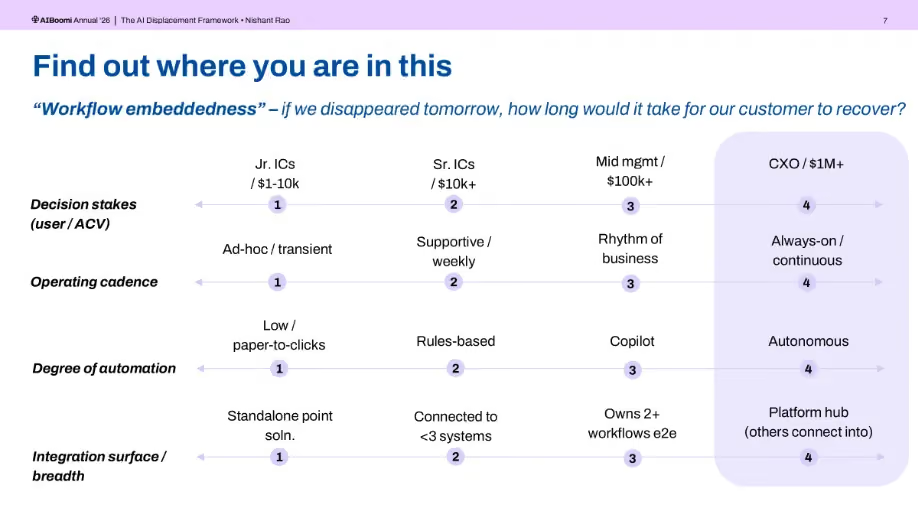
Decision stakes:
Are your users junior ICs with $1-10K ACV (1), you get a 1
Senior ICs at $10K+ - you get a 2
Mid-management at $100K+ - you get a 3
or CXO-level at $1M+ - you get a 4
Operating cadence:
Is your product used ad-hoc and transiently – 1
Is it used in a supportive/weekly rhythm – 2
As part of the rhythm of business – 3
or always-on and continuous - 4
Degree of automation:
Are you doing basic paper-to-clicks digitization - 1
Offering rules-based automation – 2
Providing copilot-level assistance - 3
Performing complete autonomous execution - 4
Integration surface:
Are you a standalone point solution – 1
Connected to fewer than 3 systems – 2
Owning more than two workflows end-to-end – 3
Providing a platform hub that others connect into - 4
Add up your scores for each axis. Be brutally honest.
Or if you don't want to do this manually, we've created an interactive tool to get your score and where you belong on the quadrant instantly.
Testing Framework Accuracy
As a fund, we stay invested in continuously pressure-testing our framework & making updates to ensure it stays relevant in helping us separate the chaff from the wheat. This also helps us identify specific areas (think each sub-dimension) where the startup may need help. Given our #OperatingVC model, this helps us come up with concrete action items or projects we can undertake to support our portfolio company’s success.
We also ran some top SaaS companies through the latest 2x2, here’s how they rank across quadrants.
Let us know if you have any questions or clarifications, our team is always happy to be of help!
In part 2 of this post (after everyone calibrates themselves), I plan to dive deeper into the SO-WHAT? We’ll talk about the following:
- early warning signals that can help confirm you’ve diagnosed yourself into the right quadrant
- Transformation levers you can take to up-level and work to get towards the Low Risk quadrant (top-right)
- Bring to life such transformation case examples using deeper dives into work undertaken by some of our Avataar portfolio companies
It’s Reflection Time!
One of the things I’ve always valued about the AIBoomi community (formerly known as SaaSBoomi) is the relentless desire to learn through open sharing of problems, ideas, and real challenges. That willingness to stay humble and vulnerable, even when things aren’t working, is what enables real progress.
In today’s world, where AI models are compounding every millisecond, the need for brutally honest reflection is 100x more critical. If you’re too generous in your self-evaluation, you may feel good in the short term—but you risk losing the ability to compete over the long run.
My earnest request: read and embrace the Radical Candor mindset before you self-score.
Even better—do this exercise with your co-founders or your leadership team. Compare how each of you evaluates the same dimensions. I’m confident it will spark meaningful (and often necessary) debate.
Will it be uncomfortable?
Will it surface your deepest fears?
Could it disrupt your roadmap or challenge your team dynamics?
Yes. Yes. And yes.
But as founders, our first obligation is to the company — not to our comfort.

Your team members, your clients & your investors are counting on you.
Happy Reflecting!








.webp)

.webp)
.webp)
.webp)


_page-0001%20(1).avif)

.avif)