Modernizing Reverse Logistics: Assurant’s Journey from Manual Handling to Physical AI


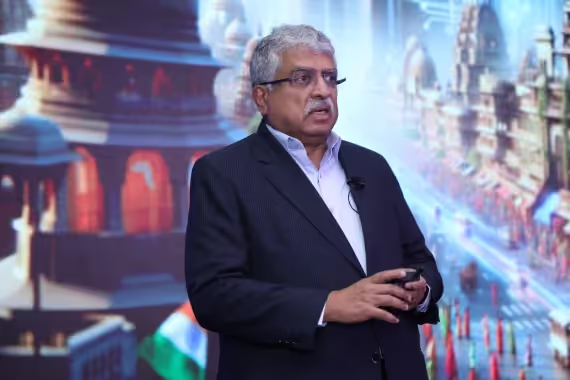
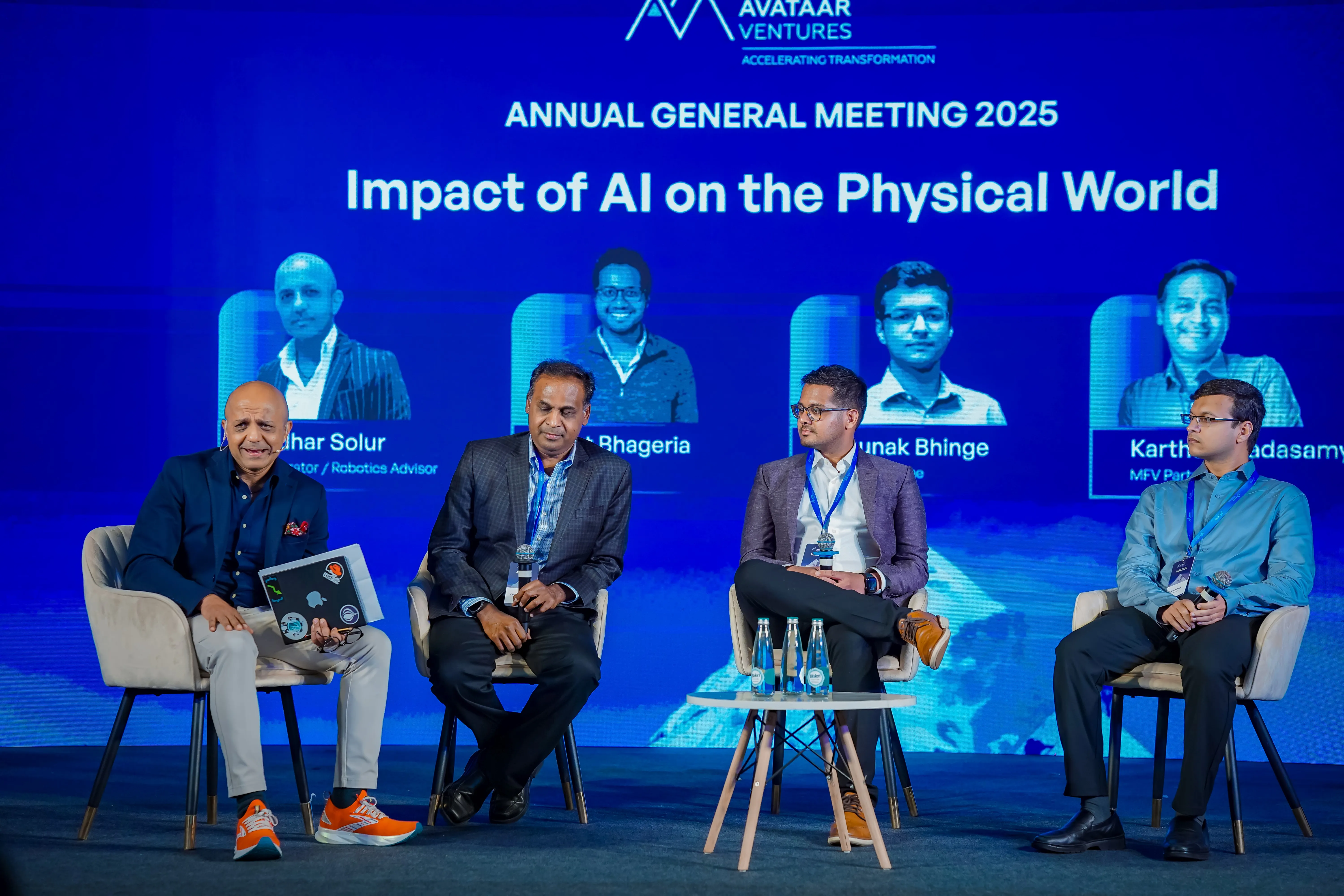
At an Avataar Dialogues event in the US, Sridhar Solur (Robotics Advisor at Avataar) and Biju Nair (EVP & President, Assurant Global Connected Living) discussed how vertical robotics is reshaping reverse logistics — and what it means for Physical AI economics.
Every September, something massive and largely invisible happens.
New phones are launched. Consumers upgrade. Old devices are boxed up at carrier stores and shipped back. Millions of phones quietly exit people’s lives.
But most of us never stop to ask a simple question: where do those phones actually go?
In many cases, they end up at Assurant — inside a 250,000–300,000 square-foot reverse-logistics operation that has quietly become one of the most compelling real-world examples of Physical AI andvertical robotics operating at scale.
This is the story Assurant President Biju Nair shared during our fireside chat. And it’s not a story about flashy robots or moonshots. It’s a story about first-principles thinking, intrapreneurship, capital efficiency, and how robotics has moved beyond the traditional coastal tech hubs into Middle America.
Reverse logistics for smartphones is brutally concrete. Boxes arrive from carrier stores and manufacturers. Devices are logged, opened, charged, triaged, and tested. Phones are cleaned — both physically and digitally. Then comes grading: A, B, or C. Finally, the phones are routed for resale.
That grading step is where the economics live. An A-grade versus a B-grade phone can mean an $80 difference in resalevalue. At millions of units, grading consistency isn’t a quality issue — it’s a balance-sheet issue.
Now layer in the real constraint.
Between September and February, Assurant sees a tsunami of 15–20 million phones. To handle that volume using traditional labor, you’d need to triple the workforce— right when labor is scarce, expensive, and exposed to repetitive-strain injuries from monotonous tasks.
This is where legacy systems break.
Innovation as Intrapreneurship, Not Theater
Assurant didn’t respond by buying generic robotic systems from integrators or licensing competitive technologies. Instead, Biju and his team treated this as an intrapreneurial problem.
They anchored everything to two simple KPIs: cost per unit and units per hour.
They funded the effort like a startup, allocating a $500K internal seed fund to a high-potential leader inside the organization. Then, they created a flywheel that changed behavior: for every dollar saved, three dollars would be reinvested back into automation.
Just as importantly, they didn’t try to boil the ocean. Progress over perfection became a mindset. Rather than horizontal robotics, they built vertical robotics —systems purpose-built around their workflow.
Smart glasses replaced handheld scanners. AI-based cosmetic evaluation removed subjectivity from grading. Automated testing and bagging eliminated inconsistency.
Here, AI wasn’t about chasing a trend. It was tied directly to economics and customer satisfaction.
Bucking the Trend — On Location, Talent,and Design
The bucking-the-trend decisions didn’t stop with technology.
Organizational design followed the same logic. Assurant is a highly matrixed company, but this robotics system reports directly to a P&L owner — not to a shared tech services group. When automation directly drives unit economics, ownership matters.
Talent strategy broke convention too. Nashville isn’t a robotics hub. Instead of importing talent, Assurant cultivated it locally—partnering with Middle Tennessee State University, building an innovation center, and investing early in students through internship straining, and clear career progression systems directly out of school.
The outcome is striking: virtually no attrition of an automation group — inside an insurance company, in a non-traditional tech city. That doesn’t happen by accident. That’s system design.
One story from the facility captures the culture better than any slide. Phones arrive with QR codes attached. To eliminate fumes and subjectivity from manual polishing, the team introduced a dry-ice cleaning system with blowers. It worked, except the QR codes blew off!
Instead of escalation or bureaucracy, the system empowered everyone to solve problems. An intern offered a simple idea: why not stamp the QR code after the blower?
It was practical. Obvious. And exactly right!
That moment reflects two deeper truths: innovation doesn’t belong to titles, and the best systems make problems easy tosolve.
As Biju put it, build products like air and water— easy to consume,hard to live without. Growth, he reminded us, comes with discomfort. Resilience isn’t optional.
Watch a drone tour of Assurant's Device Care Center
The Avataar Thesis: Vertical Systems, Vertical Data, Vertical Scaling Laws
This story isn’t just about Assurant. It’s about where Physical AI is heading.
As these vertical systems run year after year, data compounds. Every phone inspected, every defect detected, every grading decision, every exception handled becomes part of a growing vertical data asset. Over time, this enables a ChatGPT moment for reverse logistics — not a conversational interface, but a self-configuring system that learns how to route devices, tune inspection thresholds, optimize cleaning methods, predict failure modes, and rebalance throughput automatically.
This is where vertical scaling laws begin to apply. In tightly scoped systems, more data bends loss curves, improves accuracy, and strengthens economics over time. Automation doesn’t just execute — it learns.
At the same time, the broader ecosystem has shifted. Talent is democratized. Chip and sensor costs are lower. Edgecomputing is real and affordable. Foundation models are accessible. Capital efficiency matters again.
That’s why vertical robotics—deeply embedded, workflow-specific, economically grounded — is the real frontier. Notgeneral-purpose machines chasing endless use cases, but systems designed aroundpain, incentives, and compounding value.
This is the core thesis at Avataar Ventures: vertical systems, vertical data, and vertical scaling laws.
And none of this happens without people.
So real kudos to Assurant, to Biju Nair, and especially to the teams in Tennessee led by Brandon Jonhson, who brought this to life — engineers, operators, interns, and leaders who showed what’s possible when first principles meet trust, ownership, and culture.
These systems may never be seen by consumers. But they are already reshaping how the physical economy works.
And they remind us that the future of Physical AI is being built — not just in labs or on the coasts — but on factory floors, in fulfillment centers, and by teams willing to buck the trend and dothe hard work of making it real.
Watch the full fireside chat:




.webp)
.webp)
.webp)
.webp)
_page-0001%20(1).avif)
.avif)